Today’s post picks up where we left off, sharing the powerful and beautiful poetry of people’s varying resistances to annihilation. From the USA to Palestine, from Hawaii to Guatemala, these poems show us the common humanity we possess, though desperate efforts are being made to strip our commonalities away. These efforts are evident in trade and economics, militarism and war-mongering and the ongoing rush to extract resources and displace peoples in places deemed “hinterlands” by the metropoles of the present. They are evident on a social network of virtual interfaces where racist, Islamophobic, and misogynist memes and messages seem to abound.
We are one year (plus 76) into an active genocide and escalation of regional warfare the likes of which have never been seen before. The current literal weaponization of common technologies used by all, and terroristic attacks on civilians, children and women in Lebanon, the general populace– should be grounds for expulsion and ostracism from the world stage. Sanctions against Israel and its rabid parent, must be deployed to de-center and fragment the power of genocidal colonial and imperialist strategies and hegemons. But sadly the opposite is happening. If you are interested, you can have a listen here:
One of the most terrifying things has been to see colonial strategies of conquest and genocide that we have been part of over 500 years in the Americas, happening in the space of a year. The erasure and dismemberment of hundreds of thousands, the utter destruction of cultural and religious landmarks, shopping and recreational sites, health care, infrastructure sewage and sanitation gives us a sense of what historical moments must have been like in eras of physical conquest and occupation, in both settler and some extractive colonies. It’s like a time-lapse of annihilation. And so it remains ever more poignant and even necessary, to fight back with the art and writings of those who have other ways of envisioning the world in spite of our collective anomie.
Below I share poems written by Lena Khalaf Tuffaha and Adrienne Rich, exploring the depth and concerns of feminist poetry in our lifetimes.
MOUNTAIN, STONE
BY LENA KHALAF TUFFAHA
Do not name your daughters Shaymaa,
courage will march them
into the bullet path of dictators.
Do not name them Sundus,
the garden of paradise calls out to its marigolds,
gathers its green leaves up in its embrace.
Do not name your children Malak or Raneem,
angels want the companionship of others like them,
their silvery wings trailing the filth of jail cells,
the trill of their laughter a call to prayer.
Do not name your sons Hamza.
Do not taunt the torturer’s whip
with promises of steadfastness.
Do not name your sons
Muhammad Ahed Zakaria Ismail,
they will become seashells, disappear in the sand.
Do not name your children. Let them live
nameless, seal their eyelids
and sell their voices to the nightingale.
Do not name your children
and if you must
call them by what withstands
this endless season of decay.
Name them mountains,
call them stone.
What Kind of Times Are These
BY ADRIENNE RICH
There’s a place between two stands of trees where the grass grows uphill
and the old revolutionary road breaks off into shadows
near a meeting-house abandoned by the persecuted
who disappeared into those shadows.
I’ve walked there picking mushrooms at the edge of dread, but don’t be fooled
this isn’t a Russian poem, this is not somewhere else but here,
our country moving closer to its own truth and dread,
its own ways of making people disappear.
I won’t tell you where the place is, the dark mesh of the woods
meeting the unmarked strip of light—
ghost-ridden crossroads, leafmold paradise:
I know already who wants to buy it, sell it, make it disappear.
And I won’t tell you where it is, so why do I tell you
anything? Because you still listen, because in times like these
to have you listen at all, it’s necessary
to talk about trees.
SOMETHING MORE THAN FORCE
for you, who must feel the absence of this absence
Otto Rene Castillo, Guatemala
I
It’s a sharp august dusk
and I say to you all,
now I am sadder than ever.
Perhaps nobody knows
as you do, my love,
now that I’m only
a long succession of cries
inside you.
Far away,
with blows they have broken my joy
in your body,
still they can’t understand my hands
that so suddenly ripped
the dark wind from your face.
II
They don’t want
my rivers
to flow in you
They don’t like
your wings
to fly to me.
They want to ignore
the gesture of your lips
and they’ve put a dark cross
on the name you love
to repeat
over the planet.
But, love,
they cannot erase your heart
in the far away depths of your breast
as it beats my tenderness.
They can’t, love,
tear you from the heights
you live in my eyes.
They can’t my love,
rip you out of my life
because, like the sea,
I too keep something of your name
in me.
RESIST
BRANDY NĀLANI MCDOUGALL, Hawa’ii
Qawem ya sha’abi, qawemhum. Resist my people, resist them. —Dareen Tatour
Hawaiians are still here. We are still creating, still resisting. —Haunani-Kay Trask
Stand in rage as wind and current clash
rile lightning and thunder
fire surge and boulder crash
Let the ocean eat and scrape away these walls Let the sand swallow their fences whole Let the air between us split the atmosphere
We have no land No country But we have these bodies these stories this language of rage left
This resistance is bitter
and tastes like medicine Our lands
replanted in the dark and warm there
We unfurl our tangled roots stretch
to blow salt across
blurred borders of memory
They made themselves fences and bullets checkpoints gates and guardposts martial law
They made themselves
hotels and mansions adverse
possession eminent domain and deeds
They made themselves
shine
through the plunder
They say we can never— They say we will never—because because they—
and the hills and mountains have been mined for rock walls the reefs pillaged for coral floors
They say we can never— and the deserts and dunes have been shoveled and taken for their houses and highways—
because we can never— because the forests have been raided razed and scorched and we we the wards
refugees houseless present- absentees recognition refusers exiled uncivilized disposable natives
protester-activist-terrorist-resisters—
our springs and streams have been
dammed—so they say we can never return
let it go accept this
progress stop living
in the past—
but we make ourselves
strong enough to carry all of our dead
engrave their names in the clouds
We gather to sing whole villages awake
We crouch down to eat rocks like fruit
to hold the dirt the sand in our hands
to fling words
the way fat drops of rain
splatter off tarp or corrugated roofs
We remember the sweetness We rise from the plunder
They say there is no return
they never could really make us leave
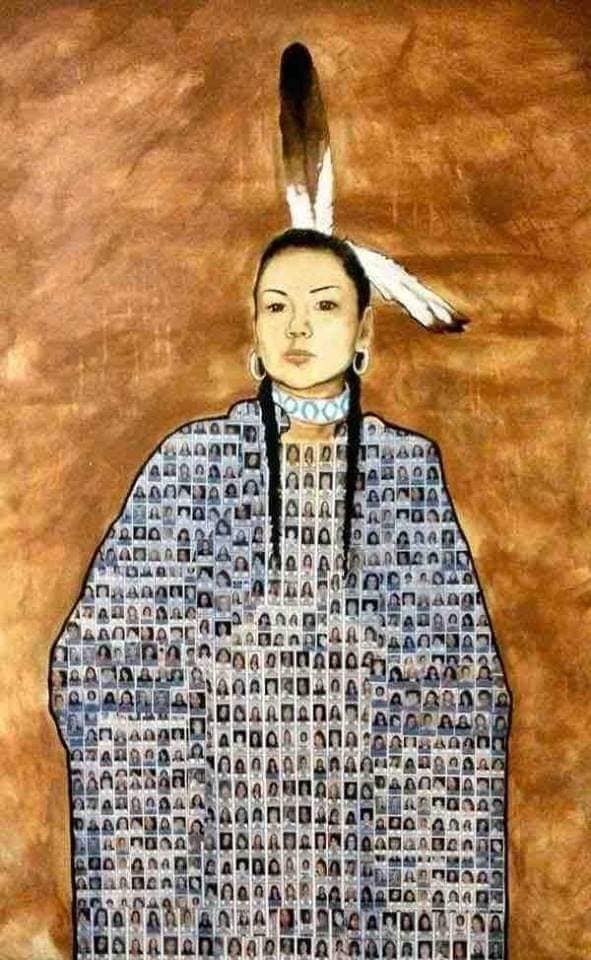
Native Women’s Shelter of Montreal
4ftx6ft Acrylic and mixed media on Canvas- 2014
The title of the painting is “Still Dancing”
The idea for the title came from my little sister:
“Dancers dance for those who cannot, the sick, the elders, and those who are
gone. It’s like all those women are still dancing thru her. “
Discover more from Ear to the Ground
Subscribe to get the latest posts sent to your email.

 Ear to the Ground